I just read the novel, "Island", by Aldous Huxley. This book came out in 1962 and tells the story of Pala, a mythical island where oil has recently been discovered. The protagonist of the story, Will Farnaby, is a British journalist and economic hitman who has been hired by corporate tycoons to negotiate with the island's royal elite for the right to extract the tiny country's oil wealth.
The job of the economic hitman is to bribe a country's leader to betray his people so that a western corporation can steal the nation's assets from them. Economic hitmen are very real and have been a major strategy of the United States to steal the wealth of the third world since Mossadegh--the democratically elected leader of Iran--was driven out of office by the CIA. For more read "Economic Hitman" by John Perkins.
During the course of his visit to Pala Will Farnaby entertains himself by taking a guided tour of the island and its remarkable culture. Pala is a utopia: its people are well-educated, well adjusted, superbly healthy in body and mind. It soon becomes obvious that Huxley's main purpose with the book is to wax on about his social theories for reasons that should be known to you, but sadly are probably not.
When one understands who Aldous Huxley is it should become clearer. Huxley was the son of T. H. Huxley, a British intellectual and member of The Royal Society. The entire Huxley family was active in British politics and policy and are, in fact, propagandists for the British empire. For example, Aldous' brother, Julian, was the first director of United Nations Educational, Scientific and Cultural Organization (UNESCO) promoting world education congenial to empire. Aldous' role was to write books that introduced key ideas (memes) into society so that when they were later proposed as policy they would not seem shocking, a phenomenon called "predictive programming".
For example, he spends a lot of time in the book describing the education of Palanese youth who are given training in the hard sciences, but also in physical and emotional health, and Buddhist spirituality. They are selected, based on their abilities and personality type, for special instruction. This may sound appealing but in the end what is revealed is education of children for the benefit of society at the expense of individualism. And what Huxley doesn't share with us is that the country's leaders get to decide which behaviors are promoted and which are not.
I was very impressed with Huxley's intelligence and insight into human nature, as it is obvious upon reading him one is dealing with a superior mind, but there is a certain tragedy to the man that came through in this book particularly. His own education was, of course, British boarding school with the attendant alienation and estrangement from family and deep love. The character Will Farnaby is, I am certain, patterned after Huxley himself, and is a thoroughly unsympathetic character who exhibits all the traits of a psychopath. This is what he had to say about his girlfriend's attempts at pregnancy:
"He was not much interested in babies and had always been thankful for those repeated miscarriages which had frustrated all Molly's hopes and longings for a child."
The best propaganda buries the lies within a spoonful of sugar and "Island" does just that. It is fitting that Huxley writes himself into this story as an economic hitman because that is what he was in real life too.
Wednesday, January 2, 2008

Thursday, November 8, 2007
Trillium Farm autumn activities
 There's a lot to do to put a homestead ready for winter. Trillium has lots of fruit trees that were planted years ago so they are mostly heirloom varieties. Here we are picking apples. We've been enjoying applesauce and apple pies, yummy!
Trillium Farm is located in a valley and unlike most valleys with steep walls and a mischevious river at the bottom, Trillium valley has broad, open meadows. This makes it an attractive site for outdoor get-togethers. Every summer groups rent the place to hold conferences.
 But in the autumn the leaves take over and they must be raked up for compost. See that little speck of color to the right? That's Janet raking away. Go Janet! When we're finished I'll post a picture of the huge pile we are creating.
We have done a little hiking here. It's not uncommon to see huge bear poops on the trails which tends to knock oneself out of one's reverie and become very present in the here and now! (But I'll spare you the picture.)
 This was a scene Connor captured at the top of a "knob" above us, looking down the Little Applegate Valley. I asked my friend Chant to explain the word, "knob", which is an intermediate high spot on a ridge on the way to a still higher one. Chant is fascinating to listen to because he has such a vast and precise vocabulary. He says things like "knob", and "draw", and "fine-fuel", and "underburn" and I'm always slowing him down to explain them to me.
I'll leave you with a picture of the sunset that Alexis insisted I take. I told her it probably wouldn't come out well but took it anyway. Having children that are smarter than you can be humbling. Oh, and you should see the stars at night!

Wednesday, October 31, 2007
Global warming is a ruse
We've encountered a few sacred cows on this journey and one of them is global warming. We've found when it is apparent to our ecologically-minded friends that we don't believe in global warming we are greeted with a response of incredulity and even indignation.
We are not certain that the globe isn't warming up, maybe it is, but the questions we have are 1) is the warming (if it exists) abnormal, and 2) is it human-caused? To claim with certainty that the globe is warming and that humans are causing it is unscientific, more like a religious position than anything else, and we remain wary of any and all religions. Consider this quote from Al Gore:
"The climate crisis is not a political issue, it is a moral and spiritual challenge to all of humanity. It is also our greatest opportunity to lift global consciousness to a higher level."
You should be very skeptical when a politician starts talking like a baptist preacher. Lift consciousness to a higher level? Seriously, what kind of gibberish is this?
We see a conspiracy behind all this global warming news that most are missing and it starts with the premier think tank, The Club of Rome, to which Al Gore is a member. Best known for their book, "The Limits to Growth", The Club of Rome made the case that industrial civilization is on a collision course with disaster (with which we concur). In a lesser known book, "The First Global Revolution", written by two Club of Rome founders in 1991, one finds this extraordinary statement:
"In searching for a new enemy to unite us, we came up with the idea that pollution, the threat of global warming, water shortages, famine and the like would fit the bill ... All these dangers are caused by human intervention and it is only through changed attitudes and behaviour that they can be overcome. The real enemy, then, is humanity itself."
Read that again and picture world leaders and their minions searching for a "new enemy to unite" (control) the world's masses and deciding on environmental issues as the key! Doesn't that put the media hyperblitz on global warming in a new light?
And then there are quotes like these from our so-called world leaders:
"No matter if the science of global warming is all phony...climate change provides the greatest opportunity to bring about justice and equality in the world." -Christine Stewart, then Canadian Minister of the Environment
"...we need to get some broad based support, to capture the public's imagination... So we have to offer up scary scenarios, make simplified, dramatic statements and make little mention of any doubts... Each of us has to decide what the right balance is between being effective and being honest." -Stephen Schneider, Stanford Professor of Climatology
"If I were reincarnated I would wish to be returned to earth as a killer virus to lower human population levels." -Prince Phillip, Duke of Edinburgh
"A total population of 250-300 million people, a 95% decline from present levels, would be ideal." -Ted Turner, major UN donor
"We are on the verge of a global transformation. All we need is the right major crisis..."
-David Rockefeller, Club of Rome executive member
"...current lifestyles and consumption patterns of the affluent middle class - involving high meat intake, use of fossil fuels, appliances, home and work-place air-conditioning, and suburban housing - are not sustainable. A shift is necessary which will require a vast strengthening of the multilateral system, including the United Nations..." -Maurice Strong, former Secretary General of UNEP, opening speech of the 1992 Rio Earth Summit
That last quote is important because it reveals the global warming agenda, namely one-world government.
To us the global warming hype looks like a psychological operation, as it offers an apparent solution to a world incredibly frustrated with the corporate damage being done everywhere. And like any psy op it is effective because it plays upon the deepest desires of most people, to live in harmony with nature. But in reality it is a misdirection, designed to throw people off the real cause of the environmental devastation and that is our money system itself. We refer here to the monetary system where the amount of "money in circulation" and the "growth of the economy" is based on how much debt can be absorbed by individuals, businesses, and governments. See the video Money as Debt to learn more.
This may sound weird because most of us are so embedded in this system and its pathological logic that we have trouble distancing ourselves enough from it to see it clearly, but just think about it. We hear things like "the economy grew only 3% this year" and that's 3% on top of last year's 3%, so we have an economy growing exponentially! Of course, the raw materials for this economy ultimately come from the earth itself, so it's not hard to see why an exponentially growing economy is completely unsustainable.
We also think humanity is not the problem because they themselves are enslaved by the system just as everything else is. To prove this to yourself, just try to live completely independent of the dominant economy for any period of time, if you can do it at all. Then think how the dominant system relies on just about everyone being in debt, and ask yourself to whom is all this debt owed? Now, you are asking the right question that will point you to the real culprits behind environmental destruction, wars, and most human misery.
No, people, don't be fooled by the hype, the problem is the corporate money system that nearly has the whole world in its clutches and is hell-bent on an agenda of complete and total control. Did you know the Islamic world considers usury immoral and rejects central banking? They are the last outpost of cultures to do so. This may put the invasion of the middle east in a new perspective for you. Once the Islamic societies are dominated the whole world will be taken over by the corporate monetary system we've all come to love so much.
Global warming is a corporate agenda, a psychological op to seduce good people into giving up their rights and freedoms, just like 9-11 and all the other ones going on all the time. Wake up.
We are not certain that the globe isn't warming up, maybe it is, but the questions we have are 1) is the warming (if it exists) abnormal, and 2) is it human-caused? To claim with certainty that the globe is warming and that humans are causing it is unscientific, more like a religious position than anything else, and we remain wary of any and all religions. Consider this quote from Al Gore:
"The climate crisis is not a political issue, it is a moral and spiritual challenge to all of humanity. It is also our greatest opportunity to lift global consciousness to a higher level."
You should be very skeptical when a politician starts talking like a baptist preacher. Lift consciousness to a higher level? Seriously, what kind of gibberish is this?
We see a conspiracy behind all this global warming news that most are missing and it starts with the premier think tank, The Club of Rome, to which Al Gore is a member. Best known for their book, "The Limits to Growth", The Club of Rome made the case that industrial civilization is on a collision course with disaster (with which we concur). In a lesser known book, "The First Global Revolution", written by two Club of Rome founders in 1991, one finds this extraordinary statement:
"In searching for a new enemy to unite us, we came up with the idea that pollution, the threat of global warming, water shortages, famine and the like would fit the bill ... All these dangers are caused by human intervention and it is only through changed attitudes and behaviour that they can be overcome. The real enemy, then, is humanity itself."
Read that again and picture world leaders and their minions searching for a "new enemy to unite" (control) the world's masses and deciding on environmental issues as the key! Doesn't that put the media hyperblitz on global warming in a new light?
And then there are quotes like these from our so-called world leaders:
"No matter if the science of global warming is all phony...climate change provides the greatest opportunity to bring about justice and equality in the world." -Christine Stewart, then Canadian Minister of the Environment
"...we need to get some broad based support, to capture the public's imagination... So we have to offer up scary scenarios, make simplified, dramatic statements and make little mention of any doubts... Each of us has to decide what the right balance is between being effective and being honest." -Stephen Schneider, Stanford Professor of Climatology
"If I were reincarnated I would wish to be returned to earth as a killer virus to lower human population levels." -Prince Phillip, Duke of Edinburgh
"A total population of 250-300 million people, a 95% decline from present levels, would be ideal." -Ted Turner, major UN donor
"We are on the verge of a global transformation. All we need is the right major crisis..."
-David Rockefeller, Club of Rome executive member
"...current lifestyles and consumption patterns of the affluent middle class - involving high meat intake, use of fossil fuels, appliances, home and work-place air-conditioning, and suburban housing - are not sustainable. A shift is necessary which will require a vast strengthening of the multilateral system, including the United Nations..." -Maurice Strong, former Secretary General of UNEP, opening speech of the 1992 Rio Earth Summit
That last quote is important because it reveals the global warming agenda, namely one-world government.
To us the global warming hype looks like a psychological operation, as it offers an apparent solution to a world incredibly frustrated with the corporate damage being done everywhere. And like any psy op it is effective because it plays upon the deepest desires of most people, to live in harmony with nature. But in reality it is a misdirection, designed to throw people off the real cause of the environmental devastation and that is our money system itself. We refer here to the monetary system where the amount of "money in circulation" and the "growth of the economy" is based on how much debt can be absorbed by individuals, businesses, and governments. See the video Money as Debt to learn more.
This may sound weird because most of us are so embedded in this system and its pathological logic that we have trouble distancing ourselves enough from it to see it clearly, but just think about it. We hear things like "the economy grew only 3% this year" and that's 3% on top of last year's 3%, so we have an economy growing exponentially! Of course, the raw materials for this economy ultimately come from the earth itself, so it's not hard to see why an exponentially growing economy is completely unsustainable.
We also think humanity is not the problem because they themselves are enslaved by the system just as everything else is. To prove this to yourself, just try to live completely independent of the dominant economy for any period of time, if you can do it at all. Then think how the dominant system relies on just about everyone being in debt, and ask yourself to whom is all this debt owed? Now, you are asking the right question that will point you to the real culprits behind environmental destruction, wars, and most human misery.
No, people, don't be fooled by the hype, the problem is the corporate money system that nearly has the whole world in its clutches and is hell-bent on an agenda of complete and total control. Did you know the Islamic world considers usury immoral and rejects central banking? They are the last outpost of cultures to do so. This may put the invasion of the middle east in a new perspective for you. Once the Islamic societies are dominated the whole world will be taken over by the corporate monetary system we've all come to love so much.
Global warming is a corporate agenda, a psychological op to seduce good people into giving up their rights and freedoms, just like 9-11 and all the other ones going on all the time. Wake up.
Trillium Farm in Southern Oregon
We've been staying a Trillium Farm for two weeks now. To say this is beautiful country barely scratches the surface. Located out in the woods near Jacksonville, Oregon, Trillium is a wilderness wildlife sanctuary, so the landscape here is not so screwed up as most places.
Trillium has a long history and used to be a thriving community, but the combination of people issues (folks not paying dues and keeping up the farm) and a couple of floods knocked the community back to just Chant and Susanna Thomas, whose goal is to rebuild the membership with the right folk.
 We've hit it off really well with Chant and Susanna, who are very educated and cultured and generous. We've been learning ten new things a day hanging out with them.
We are living in our trailer, pulled onto their property, of course. It's been getting cold at night and fortunately, they're giving us electricity without which we probably wouldn't be able to stay in this part of the country at this time of year.
There are a million things to do around here, so they are grateful for our energy to help get things ready for winter.
Trillium has a long history and used to be a thriving community, but the combination of people issues (folks not paying dues and keeping up the farm) and a couple of floods knocked the community back to just Chant and Susanna Thomas, whose goal is to rebuild the membership with the right folk.
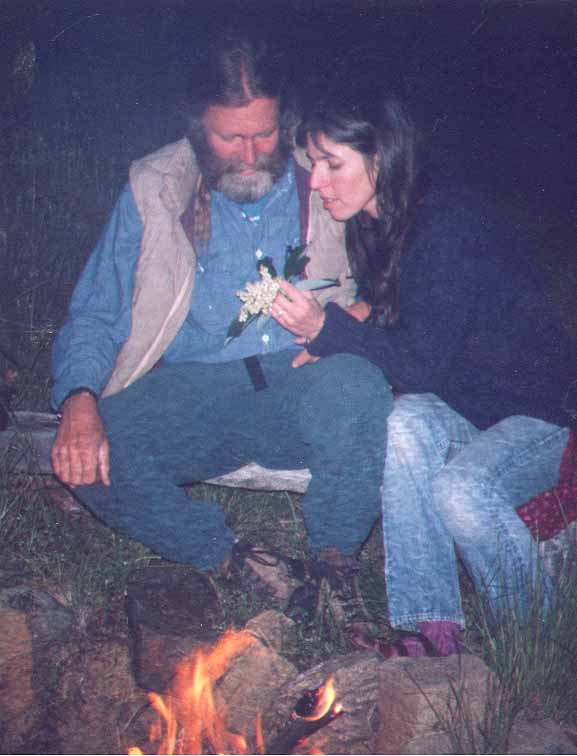 We've hit it off really well with Chant and Susanna, who are very educated and cultured and generous. We've been learning ten new things a day hanging out with them.
We are living in our trailer, pulled onto their property, of course. It's been getting cold at night and fortunately, they're giving us electricity without which we probably wouldn't be able to stay in this part of the country at this time of year.
There are a million things to do around here, so they are grateful for our energy to help get things ready for winter.
Monday, October 29, 2007
Yamhill Co-op
We made a short trip up to Portland to visit Yamhill Co-op. Here is their description:
Forest Agriculture Co-op Forming in Yamhill County, Oregon. Couple looking to share 30 idyllic acres of trees, meadows, pond and seasonal creek in wine country 30 miles southwest of Porland. Live in main house or build own yurt. Many skills needed; flexible arrangements. We are literary, artistic, secular humanists connected to the natural world through reason and experience. We are looking for like-minded people who are industrious, community-minded, tree-huggers. Contact Pam & John.
Sounds good, eh? I had to look up what a "secular humanist" is, just so I wouldn't appear illiterate when I called them up.
Yamhill is a nice piece of land (30 acres) owned by a middle-aged couple who want to preserve the land, and also want to make it more productive by applying permaculture principles. They just don't know how nor do they have the time and energy required. Another great feature of this situation is their neighbor, Jim, who owns 60 acres further up the hill and who is in accordance Yamhill's plans.
There is a lot of great potential here for a small livelihood selling to the city of Portland, only 30 minutes away. We could envision U-pick berries, a goat farm, a bed and breakfast, etc.
We only stayed for a couple of days, unfortunately. We've had the same experience every place we've visited where our hosts establish the duration of our stay before we arrive. This is wise from their perspective because what if we turn out to be insufferable jerks? But when they realize we're cool the deadline disappears. Unfortunately in this case, we took it seriously and had made other plans!
So, we hope to visit Pam and John again soon.
Forest Agriculture Co-op Forming in Yamhill County, Oregon. Couple looking to share 30 idyllic acres of trees, meadows, pond and seasonal creek in wine country 30 miles southwest of Porland. Live in main house or build own yurt. Many skills needed; flexible arrangements. We are literary, artistic, secular humanists connected to the natural world through reason and experience. We are looking for like-minded people who are industrious, community-minded, tree-huggers. Contact Pam & John.
Sounds good, eh? I had to look up what a "secular humanist" is, just so I wouldn't appear illiterate when I called them up.
Yamhill is a nice piece of land (30 acres) owned by a middle-aged couple who want to preserve the land, and also want to make it more productive by applying permaculture principles. They just don't know how nor do they have the time and energy required. Another great feature of this situation is their neighbor, Jim, who owns 60 acres further up the hill and who is in accordance Yamhill's plans.
There is a lot of great potential here for a small livelihood selling to the city of Portland, only 30 minutes away. We could envision U-pick berries, a goat farm, a bed and breakfast, etc.
We only stayed for a couple of days, unfortunately. We've had the same experience every place we've visited where our hosts establish the duration of our stay before we arrive. This is wise from their perspective because what if we turn out to be insufferable jerks? But when they realize we're cool the deadline disappears. Unfortunately in this case, we took it seriously and had made other plans!
So, we hope to visit Pam and John again soon.
Wednesday, October 10, 2007
House Alive
House Alive is not a community, but the private homestead of Coenraad and Khaliqa Rogman (pronounced Con-rad and Kah-lee-kah). We first met these good people on the web and they invited us to stay with them when in Oregon. Well, we made it to Oregon, didn't we?
What the Rogmans have done is a fine object lesson for anyone. They have a lovely property in the country and have built a very nice business teaching workshops on how to build with natural materials, "cob" and "bale" being their specialties. People come from all over the world to learn from them. This kind of entrepreneurism takes a lot of initiative and attention to detail and is quite admirable. Any community would benefit by taking similar steps.
 The Rogmans built their home with conventional sticks and plywood, but on the interior they used straw bale so their walls are two feet thick and very well insulated.
 "Cob", a mixture of clay, sand, and sometimes straw is used to cover the straw bails.
Their home has a cozy, inviting feeling and the vaulted ceiling makes it seem larger than it is. The place is charming and just plain livable.

Their front porch has a very high ceiling and they have strung silks from the rafters for their children to learn on. You may have seen performers working the silks in a circus perhaps. Cirque du Soleil often features silk performances.
We got to learn a little about cobbing while we were there. We had just missed a workshop, but there was still some finish work to do on a couple of the structures. Here some windows needed to be added after the cob had dried, so Coenraad cut an outline with a rotary saw, and Janet dug two
  inches of cob out. Then, the window is mudded in.
Cob produces some of the most beautiful, compelling, and sweet buildings I can think of. This is the stuff that Tolkien's "hearth and home" is made from! Below is an example of a nearly finished cob house that we saw at Cobville, near Mountain Home.
I particularly admired Coenraad's teaching style. He understands that a person learns by doing and so he gives just enough direction to get you past a rut and lets you experiment to find your own style. Khaliqa made some wonderful meals and we really enjoyed sharing meals and good times with these wonderful people.
If you are interested in learning more about cob, take a House Alive workshop.
What the Rogmans have done is a fine object lesson for anyone. They have a lovely property in the country and have built a very nice business teaching workshops on how to build with natural materials, "cob" and "bale" being their specialties. People come from all over the world to learn from them. This kind of entrepreneurism takes a lot of initiative and attention to detail and is quite admirable. Any community would benefit by taking similar steps.
 The Rogmans built their home with conventional sticks and plywood, but on the interior they used straw bale so their walls are two feet thick and very well insulated. "Cob", a mixture of clay, sand, and sometimes straw is used to cover the straw bails.
Their home has a cozy, inviting feeling and the vaulted ceiling makes it seem larger than it is. The place is charming and just plain livable.

Their front porch has a very high ceiling and they have strung silks from the rafters for their children to learn on. You may have seen performers working the silks in a circus perhaps. Cirque du Soleil often features silk performances.
We got to learn a little about cobbing while we were there. We had just missed a workshop, but there was still some finish work to do on a couple of the structures.
 Here some windows needed to be added after the cob had dried, so Coenraad cut an outline with a rotary saw, and Janet dug two
  inches of cob out. Then, the window is mudded in.
Cob produces some of the most beautiful, compelling, and sweet buildings I can think of. This is the stuff that Tolkien's "hearth and home" is made from! Below is an example of a nearly finished cob house that we saw at Cobville, near Mountain Home.

I particularly admired Coenraad's teaching style. He understands that a person learns by doing and so he gives just enough direction to get you past a rut and lets you experiment to find your own style. Khaliqa made some wonderful meals and we really enjoyed sharing meals and good times with these wonderful people.
If you are interested in learning more about cob, take a House Alive workshop.
Tuesday, October 9, 2007
Mountain Homestead in Oregon
After a month-long journey across the continent we arrived at Mountain Homestead in Coquille, Oregon. This was a community that Janet had picked out of the Communities Directory and they were nice enough to host us. We've found communities need a fair amount of advance warning before your arrival so they can “be ready”. What they need to be ready for is less clear, however. Every place we've been we just show up with work clothes on and ask where we can help, an approach that has been pretty well-received.
Mountain Home is in a valley on the Pacific side of Oregon's coastal mountains, so it stays pretty dry in the summer but gets a ton of rain in the winter.
The valley is steep so there is a great deal of slope on the land, which the community is dealing with by building a series of terraces that add topography and serve to keep water on the property. It is a lot of hard work to do this, and while they could do it by hand they use a tractor instead. This is the work I did during the two weeks we stayed there.
Because the land is heavily wooded trees must be pushed over where the terraces are to be. A cable is wrapped around the tree, the other end tied to a tractor and the tree comes crashing down. But it's rarely that easy. Often roots need to be chopped, or the tractor may not have room to pull, or the tree must fall in a different direction than the tractor is pulling. In these cases, the cable is routed through a pulley attached to another tree which causes the tree to fall in the right direction. (Without a tractor a “block and tackle” would be used.)

Doing this kind of “ecoforestry” I got to drive the tractor (thanks, Eli) operate a chain saw, and swing a machete, so I am even more of a man now than I was before. I also got a horrendous case of poison oak so the trees had their revenge!
Janet got to do a lot of gardening and helped prepare the lunch meal one day. She dug up potatoes, preserved kale seeds, and helped build cold frames.
Children!
There were some wonderful children at Mountain Home roughly the same ages as Connor and Alexis. A boy named River was Connor's bud, as was seven year old Julius. Imani and Nia, Julius' sisters, made wonderful companions for Alexis. There have usually been children where we stay, but at Mountain Home we hit the jackpot. Unfortunately, the families with children appear to be moving away soon, so bummer!
Vegans vs. meateaters
A conflict was in its end-game when we arrived. Apparently, the vegans in the community opposed the raising of animals for food, and those who wanted to raise goats for milk and meat apparently lost out and were preparing to leave (perhaps for other reasons too). Unfortunately, these were the families with children.
Throughout this journey we've encountered vegetarianism (may eat eggs and dairy, but no meat) and veganism (eats plant sources only). The main justification we've heard for these diets is a sort of spiritualism that translates to “I don't want to kill anything for a meal.” We don't want to kill an animal either, but we think meat is part of a healthy diet so we'll do what we must. We are open to a biological or anthropological justification for vegetarianism/veganism, but haven't heard it yet. Instead we see a lot of dietary practices that are obviously unhealthy like the consumption of soy. Becoming malnourished has never been an interest of ours, even if it feels good spiritually, and an omnivorous community remains one of our criteria.
Winter comes on
We arrived in Oregon in September, just when it started getting cold. Unlike the flat places in the country, here in the mountains there are what are known as “micro-climates”, which may be warmer or colder for various reasons. In a valley bottom, like Mountain Home's, the air rises during the day as it is heated by the sun. At night, however, the cool air goes back down the valley and causes people living in trailers to shiver uncontrollably. Also, because we were in a valley, the sun shown on our solar panel only a few hours a day, and since we rely on the battery for lights and most especially the refrigerator (electronic ignition lights the propane) we had a very hard time keeping the battery charged. We're still working out this solar thing!
So, in a quest for warmth, we moved on from Mountain Home, but we'll go back there and help them out. They are doing a lot of interesting things and are laying the groundwork for a fantastic food forest.
Thank you Mountain Home!
Subscribe to:
Posts (Atom)

